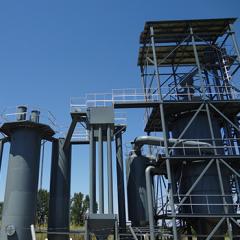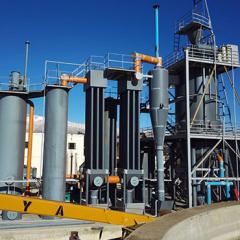
- 1. Biomass Storage
- 2. Biomass Conveyor
- 3. Biomass Buffer Bin
- 4. Biomass Gasifier
- 5. Cyclone Dust Collector
- 6. Gas Filter
- 7. ESP
- 8. Gas Scrubber
- 9. Gas Dryer
- 10. Blower
- 11. Buffer Tank
- 12. Gas Flare
- 13 Gas Generator Sets

Wood Waste Gasification Power Plant


Wood Waste Gasification Power Plant
Convert wood waste, sawdust and forestry residues into reliable electricity with Powermax biomass gasification power plants.
✓ Power Range: 50kW-20MW
✓ Fuel: Wood chips, sawdust, branches, bark
✓ Gasifier Type: CFBG & TFBG
✓ Application: Industrial power generation

POWERMAX WOOD WASTE GASIFICATION POWER PLANT
The basic principle of POWERMAX’s wood waste biomass gasification power generation system(abbreviated as BGPS) is to convert wood chips,saw dust,branches,bark,forestry residues and etc. into combustible gas . It is then used as fuel in gas engine to generate electricity. Biomass gasification successfully conquers the disadvantages of wood waste biomass, such as low flammability and wide diversity. Biomass gasification system is characteristic of small land requirement and environment friendly. It’s one of the most effective way of biomass utilization.Necessary Requirement of Wood Waste can be used in POWERMAX Wood Waste Gasification Power Plant:
Humdity of wood waste less than 20%. Size less than 15mm For Circulating Fluidized Bed Gasifier(CFBG series)
Humdity of wood waste less than 20%. Size less than 10-75mm For Twin-Fire Fixed-bed Gasifier(TFBG series)

POWERMAX WOOD WASTE GASIFICATION POWER PLANT PROCESS
Our biomass(wood waste) gasification process includes three steps. The First step is biomass gasification, which convert wood waste into syngas. The Second step is syngas purification. The producer gas coming from gasifier usually contains contaminants including dust, coke, tar and etc. The contaminants will be removed by the purification system to ensure normal operation of gas engine. The Third step is power generating in gas engine. The high temperature exhaust gas may be reused by waste heat boiler to generate steam or hot water for civil or industrial use). Steam turbine may also be considered to make a gas-steam combined cycle power plant, which will increase the total efficiency.Technology Of POWERMAX Wood Waste Gasification Power Plant
The POWERMAX wood waste gasification power generation systems are based on a modular concept and are able to applicable for 50-20000KW wood waste biomass power station. There are two series of biomass gasification system offered by POWERMAX which ranges from 50-2000KW of power generation: CFBG (Circulating Fluidized Bed Gasifier) Series, TFBG(Twin-Fixed Bed Gasifier) Series. A series biomass generator sets from 50KW to 1000KW are developed by POWERMAX to combine with POWERMAX advanced gasification technology. These gas generator sets are using the high efficiency Siemens technology alternators, Chinese top brand medium speed gas engine(500-1000rpm),German Detuz Gas Engine(1500rpm) with advanced European engine control systems. The high performance of the POWERMAX biomass gasification plants and the later production of electricity with the gensets represents a competitive solution when compared with conventional boiler-fired system.
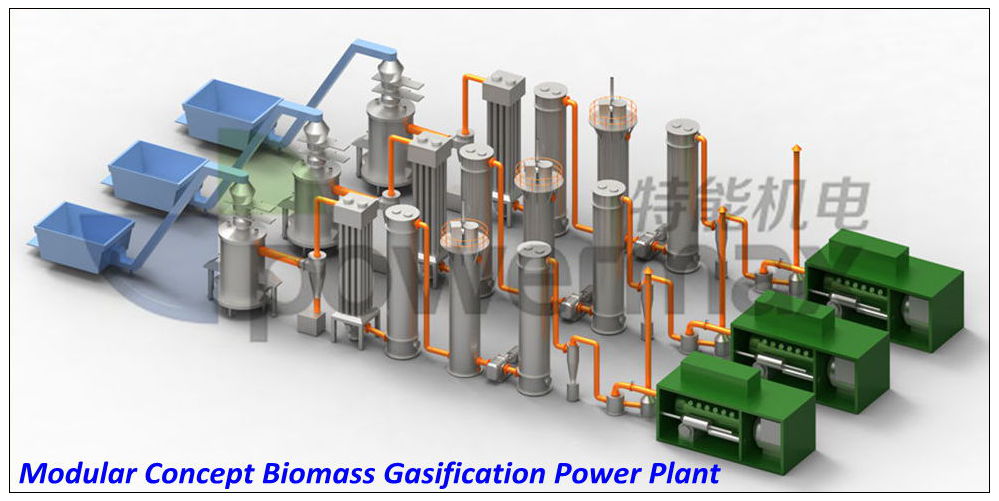
Powermax CFBG Power Plant

Technical Specification of CFBG series Biomass Gasification Power Generation System
| Model | 200CFBG | 400CFBG | 500CFBG | 600CFBG | 800CFBG | 1000CFBG | 1200CFBG | 1500CFBG | 2000CFBG |
| Rated Power(kw) | 200 | 400 | 500 | 600 | 800 | 1000 | 1200 | 1500 | 2000 |
| Rated Frequency | 50 /60 HZ | ||||||||
| Rated Voltage(V) | 220 / 400 / 440 / 6300 / 6600 / 11000 /13800 | ||||||||
| Model of Gasifier | CFBG200 | CFBG400 | CFBG500 | CFBG600 | CFBG800 | CFBG1000 | CFBG1200 | CFBG1500 | CFBG2000 |
| Gasifier Type | Circulating Fluidized Bed Gasifier(CFBG) | ||||||||
| Biomass Moisture Requirement | ≤20%(wet basis) | ||||||||
| Biomass Size Requirment | ≤8-15mm | ||||||||
| Biomass Consumption(Kg/hr) | 200-360 | 400-720 | 500-900 | 600-1080 | 800-1440 | 1000-1800 | 1200-2160 | 1500-2700 | 2000-3600 |
| Gas Production(Nm3/h) | 500-600 | 1000-1200 | 1250-1500 | 1500-1800 | 2000-2400 | 2500-3000 | 3000-3600 | 3750-4500 | 5000-6000 |
| Ash Discharge Type | Dry Ash Type | ||||||||
| Type of Gas Purification | POWERMAX Semi Dry Type Gas Purification System | ||||||||
| Heat Value of Gas | 1200-1300Kcal/Nm3 | ||||||||
| Gas Composition | CO-12~18%, CO2-10~16%, CH4-4~8% H2-3~7% CnHm-1~1.4% O2-0.5~1.2% N2-54~60% | ||||||||
| Model of Gensent | 100GFLS | 400GFLS | 500GFLS | 300GFLS | 400GFLS | 1000GFLS | 400GFLS | 500GFLS | 1000GFLS |
| Qty of Genset | 2 | 1 | 1 | 2 | 2 | 1 | 3 | 3 | 2 |
-
2MW CFBG POWER PLANT

-
0.5MW CFBG POWER PLANT-2

-
3MW CFBG POWER PLANT

-
0.5MW CFBG POWER PLANT


- 1.Elevator
- 2.Feed Bin
- 3.Gasifier
- 4.Cyclone
- 5.Tube Type Dust Remover
- 6.Venturi
- 7.Cyclone Hydraulic Separators
- 8.ESP
- 9.Indirect Cooler
- 10.Water Drop Catcher
- 11.Roots Blower
- 12.Buffer Tank
- 13.Vent Cans&Gas Flare
- 14.Tubular Heat Exchanger
- 15.Gas Generator Set
- 16.Cooling Tower
- 17.Air Blower
- 18.Water Pump
- 19.Cooling Water Pool
- 20.Condensate Water Pool
- 21.Tar Tank
- 22.Biochar Outlet

Powermax TFBG Power Plant

- 1. Skip Charger
- 2. Biomass Gasifier
- 3. Dry Ash Discharger
- 4. Cyclone Dust Collector
- 5. Hot Air Heat Exchanger
- 6. Air Cooler
- 7. Gas Cooler
- 8. ESP
- 9. Gas Cooler
- 10. Gas Dryer
- 11. Buffer Tank
- 12. Gas Flare
- 13. Gas Generator Sets
- 14. Blower
- 15. Gas Compressor
Technical Specification of TFBG series Biomass Gasification Power Generation System
| Model | 50TFBG | 100TFBG | 200TFBG | 300TFBG | 400TFBG | 500TFBG | 600TFBG | 800TFBG | 1000TFBG | 1200TFBG | 1500TFBG | 2000TFBG |
| Rated Power(kw) | 50 | 100 | 200 | 300 | 400 | 500 | 600 | 800 | 1000 | 1200 | 1500 | 2000 |
| Rated Frequency | 50 /60 HZ | |||||||||||
| Rated Voltage(V) | 220 / 400 / 440 / 6300 / 6600 / 11000 /13800 | |||||||||||
| Model of Gasifier | TFBG50 | TFBG100 | TFBG200 | TFBG300 | TFBG400 | TFBG500 | TFBG600 | TFBG800 | TFBG1000 | TFBG1200 | TFBG1500 | TFBG2000 |
| Gasifier Type | Twin-Fire Fixed Bed Gasifier | |||||||||||
| Biomass Moisture Requirement | ≤20~35%(wet basis) | |||||||||||
| Biomass Size Requirment | Diameter 20mm-80mm;Length 10-80mm; | |||||||||||
| Biomass Consumption(Kg/hr) | 50-100 | 100-200 | 200-400 | 300-600 | 400-800 | 500-1000 | 600-1200 | 800-1600 | 1000-2000 | 1200-2400 | 1500-3000 | 2000-4000 |
| Gas Production(Nm3/h) | 125-150 | 250-300 | 500-600 | 750-900 | 1000-1200 | 1250-1500 | 1500-1800 | 2000-2400 | 2500-3000 | 3000-3600 | 3750-4500 | 5000-6000 |
| Ash Discharge Type | Wet Ash Type/ Dry Ash Type | |||||||||||
| Type of Gas Purification | Dry Type Gas Purification System | |||||||||||
| Heat Value of Gas | ≥1200Kcal/Nm3 | |||||||||||
| Gas Composition | CO-15~20%, CO2-8~12%, CH4-upto 3% H2-15~20% N2-45~50% | |||||||||||
| Model of Gensent | 50GFLS | 100GFLS | 100GFLS | 300GFLS | 400GFLS | 500GFLS | 300GFLS | 400GFLS | 1000GFLS | 400GFLS | 500GFLS | 1000GFLS |
| Qty of Genset | 1 | 1 | 2 | 1 | 1 | 1 | 2 | 2 | 1 | 3 | 3 | 2 |
-
2*200KW TFBG POWER PLANT

-
1MW TFBG POWER PLANT

-
1000KW TFBG POWER PLANT

-
2MW TFBG POWER PLANT


- 1.Elevator
- 2.Gasifier
- 3.Cyclone
- 4.Air Cooler
- 5.Indirect Cooler
- 6.ESP
- 7.Isolation Seal
- 8.Booster Fan
- 9.Indirect Cooler
- 10.Water Drop Catcher
- 11.Water Bleeding
- 12.Gas Flare
- 13.Buffer Tank
- 14.Gas Generator Set
- 15.Air Blower
- 16.Cooling Tower
- 17.Water Pump
- 18.Cooling Water Pooling
- 19.Condensate Water Pool
- 20.Tar Tank
- 21.Hot Air Heat Exchanger

Wood Waste Gasification Power Plant Projects
Our wood waste gasification projects show how wood chips can be converted into electricity through gasification, syngas treatment and gas engine generation. The following cases cover industrial self-generation in Malaysia and grid-connected power generation in Taiwan, with configurations matched to each project.
3 MW Wood Chip Gasification Power Plant in Malaysia
Project Overview
|
Item |
Project details |
|
Customer |
MIE Industrial |
|
Location |
Malaysia |
|
Feedstock |
Wood chips |
|
Project capacity |
3 MW |
|
Power application |
On-site electricity for a wood pellet plant |
|
Project status |
In operation |
Customer Background and Requirements
MIE Industrial needed a dependable electricity supply for its wood pellet plant. High production loads and rising grid electricity costs made on-site generation an important consideration. The client wanted to use wood chips for power generation while reducing reliance on purchased electricity and supporting its emissions reduction goals.

Project site and equipment layout at the 3 MW wood chip gasification power plant in Malaysia.
Powermax System Configuration
We configured the project with two TFBG1500 twin-fire fixed-bed gasifiers and six 500 kW gas engine generator sets. Wood chips are pretreated to control moisture before feeding into the gasification system. The resulting syngas passes through multi-stage gas purification to control tar and protect the engines before electricity generation.
|
Item |
Project details |
|
Gasification equipment |
2 × TFBG1500 twin-fire fixed-bed gasifiers |
|
Power generation |
6 × 500 kW gas engine generator sets |
|
Fuel preparation |
Wood chip pretreatment and moisture control |
|
Syngas treatment |
Multi-stage gas purification |
|
Heat recovery |
Generator waste heat used for steam and hot water |
The system also recovers waste heat from the generator sets to supply steam and hot water for other plant processes. This connects the pellet plant’s electricity demand with useful heat recovery within the same project.


Gasifier and feeding equipment (left) and the gas engine generator hall (right) at the Malaysia project.
Project Progress and Results
The project is in operation, with annual operating time exceeding 8,000 hours. On-site wood chip power generation reduces the plant’s dependence on public grid electricity. Heat recovery supplies additional energy for plant processes, improving the use of the biomass fuel beyond electricity generation.
500 kW Wood Chip Gasification Power Project in Taiwan
Project Overview
|
Item |
Project details |
|
Customer |
Jiayuan Technology |
|
Location |
Taiwan |
|
Feedstock |
Wood chips with moisture content ≤15% |
|
Feedstock consumption |
500–750 kg/h |
|
Generator configuration |
2 × 300 kW gas generator sets |
|
Generation mode |
Grid-connected |
|
Actual stable output |
500 kW |
Customer Background and Requirements
Jiayuan Technology’s project in Taiwan uses wood chips for grid-connected power generation. The application requires controlled fuel moisture and a treated gas supply for two 300 kW generator sets.
Powermax System Configuration
We integrated wood chip feeding and gasification with gas cooling and cleaning before the gas reaches the engines. The project’s wood chip moisture specification is 15% or less, with fuel consumption of 500–750 kg/h. The recorded gasifier operating temperature is 1,000°C.

Wood chip receiving hopper and feeding conveyor at the Taiwan project.
Project Progress and Operating Results
The project achieves 500 kW of actual power generation during stable operation. The two 300 kW generator sets provide a combined rated capacity of 600 kW; the 500 kW figure refers to the recorded operating output. The following values describe this project’s operating conditions.
|
Operating parameter |
Recorded value |
|
Gasifier temperature |
1,000°C |
|
Purified gas temperature |
45°C |
|
Purified gas tar content |
20 mg/Nm³ |
|
Gas calorific value |
5 MJ/Nm³ |
|
Actual stable power output |
500 kW |


Gasification and syngas treatment equipment (left) and the generator control cabinet and enclosed equipment (right) in Taiwan.
Planning a Wood Waste Gasification Power Project?
Tell us your wood waste type, available quantity, moisture content, target power output and project location. We can assess the fuel preparation, gasification, syngas cleaning and generator configuration for your application, including on-site consumption, grid connection and heat recovery where required.
FAQ
-
What types of wood waste can a Powermax gasification power plant use?
Powermax wood waste gasification power plants can use wood chips, sawdust, branches, bark and forestry residues, with the gasifier and fuel preparation system selected for the material. Fuel suitability depends on moisture content, particle size, ash content and impurities. We assess your wood waste composition and available quantity before recommending a CFBG or TFBG configuration. Mixed feedstocks require evaluation of their composition and mixing ratio.
1 -
Does wood waste need drying or size reduction before gasification?
Wood waste may need drying, chipping or screening to meet the selected gasifier’s feedstock requirements. Our CFBG specifications list a maximum moisture content of 20% on a wet basis. TFBG requirements depend on the selected configuration. Drying is required when moisture exceeds the confirmed inlet limit. Oversized material may need chipping, while the proportion of sawdust and other fines must be assessed for the feeding system and gasifier.
2 -
How much electricity can a wood waste gasification power plant generate?
Electricity output depends on the wood waste supply rate, moisture content, lower heating value and the selected gasification and generator configuration. A fixed electricity yield per tonne cannot be applied to every wood waste project. Gross output is the electricity generated before deducting plant consumption. Net output is the electricity available after supplying equipment such as conveyors, fans, pumps and gas cleaning systems. We use your fuel data and operating requirements to estimate both outputs.
3 -
Can the wood waste gasification power plant operate continuously?
Powermax wood waste gasification power plants are designed for continuous industrial operation, with planned maintenance and shutdowns. Actual operating availability depends on consistent fuel quality, reliable feedstock supply, trained operators, spare parts and maintenance. Gasification, gas cleaning and generator equipment all require inspection and servicing. The operating schedule and maintenance plan should therefore be established for the selected equipment and actual fuel conditions.
4 -
What information is needed for a wood waste gasification power plant quotation?
To prepare a suitable proposal and quotation, you need: Wood waste type, composition and available daily quantity. Moisture content, particle-size distribution and available fuel analysis. Required net electrical output and daily operating hours. Project location and site conditions. Whether electricity will be used on-site, exported to the grid or supplied to an off-grid load. Any requirements for drying, steam, hot water or other heat recovery. Project cost depends on the required fuel preparation, gasification, gas cleaning, generator equipment and scope of supply.
5
Feedback form contact with us
Related Product

Biomass Gasification Power Plant
Turn biomass into power with a complete gasification-to-electricity solutio...
Learn More