

10 MW Biomass Power Plant | Powermax Turnkey Gasification Solution
For industrial operators, intensive agricultural processors, and global project developers seeking a scalable 10 MW biomass power plant, Powermax delivers a complete, field-proven gasification-based power generation infrastructure. Our engineering solution seamlessly converts locally available agricultural and forestry residues into clean baseload electricity—operating 24/7 with high thermodynamic efficiency, ultra-low emissions, and robust revenue optimization from biochar sequestration.
Why Choose Powermax for Your 10 MW Biomass Power Plant?
| Operational Challenge | Powermax Engineering Solution |
| Unstable grid / severe diesel dependence | Continuous 8,000+ annual hours of operation, configured for island-mode or seamless grid-connection. |
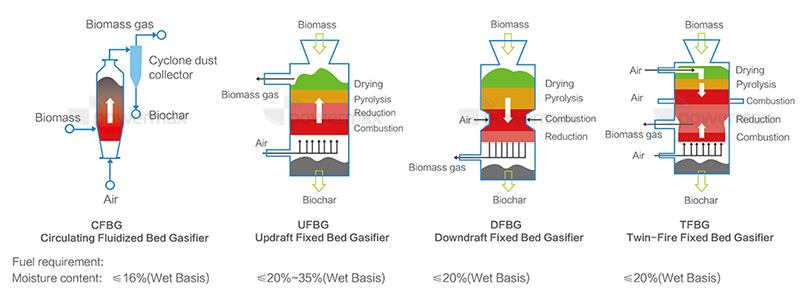
| High fuel moisture variations (up to 55%) | UFBG updraft fixed-bed gasifiers handle wet feedstock directly—eliminating expensive pre-drying lines. |
| Fine, low-density feedstocks (rice husk, sawdust) | CFBG circulating fluidized-bed systems optimize fluidization and gasification kinetics for fine particles. |
| Tar and particulate carryover damaging engines | Advanced Dry ESP lines paired with multi-stage indirect cooling to deliver ultra-clean, tar-free syngas. |
| Low overall plant thermal efficiency | Integrated CHP architecture: captures waste exhaust heat to deliver continuous industrial steam or hot water. |
| Unrealized byproduct revenue streams | High-purity biochar output optimized for premium soil amendment and immediate carbon removal (CDR) credit monetization. |
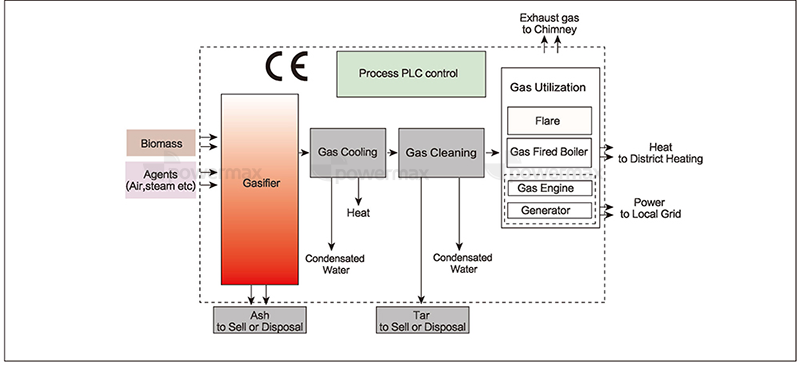
Technical Architecture: 10 MW Biomass Gasification Plant Scope
A turnkey Powermax 10 MW utility-scale system comprises the following tightly integrated industrial blocks:
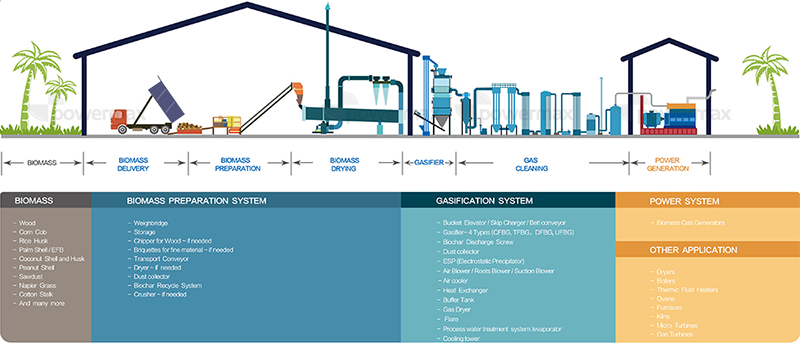
- Automated Feedstock Logistics: Heavy-duty storage, sorting, and airtight double-lock feeding setups engineered for multi-fuel flexibility (rice husk, wood chips, palm EFB briquettes, and straw).
- Gasification Island Block: Modular scaling utilizing optimized gasification trains (such as 2 × 5 MW or 4 × 2.5 MW configurations) to match specific biomass behaviors.
- Dry Syngas Purification Train: High-efficiency cyclones working in series with heavy-duty ESPs and indirect tube coolers to drive tar content down below 50 mg/Nm³.
- Power Generation Hall: Heavy-duty, medium-speed gas engine generator sets (500–1500 rpm) coupled with premium Siemens alternators for stable power quality.
- Thermal Energy Recovery (CHP): Waste heat recovery boilers designed to convert engine exhaust into pressurized industrial steam or high-temperature water loops.
- Automated Biochar Discharge: Continuous, cooled dry ash handling systems that isolate pure biochar for agricultural application or permanent carbon credit registry.
Key Engineering Parameters (10 MW Plant Design)
| Design Parameter | Guaranteed Value |
| Rated Power Output | 10,000 kW (Continuous Baseload) |
| Feedstock Consumption | ~4.0 – 6.0 Tons/Hour (Subject to fuel LHV variations) |
| Syngas Lower Heating Value (LHV) | 1,200 – 1,800 kcal/Nm³ |
| Cold Gas Efficiency | 70% – 75% |
| Overall Co-generation (CHP) Efficiency | 85% – 90% |
| Annual Available Runtimes | > 8,000 Hours |
| Approximate Plant Footprint | 1,200 – 1,500 m² (Optimized Modular Layout) |
Proven Large‑Scale Reference: Shwelaung, Myanmar 12 MW Project
Location: Shwelaung, Myanmar
Commissioning Status: Multi-phase deployment (6 MW fully commissioned and operational, designed for 12 MW capacity expansion)
Primary Feedstock: Regional agricultural rice husk
System Scope: 12 rice-husk-optimized DFBG gasifier modules + 12 automated syngas purification trains + 27 × 500 kW medium-speed gas gensets (24 duty / 3 operational standby) + centralized gas stabilization buffer tank architecture.
Quantifiable Operational Milestones:
• 24/7 Industrial Independence: Secures reliable base load power for massive localized rice milling, feed processing, and aquaculture operations, successfully bypassing regional grid instabilities.
• Complete Diesel Substitution: Zero operational dependence on high-cost diesel fuel by converting local milling waste into clean electricity.
• Byproduct Circular Economy: Generates continuous streams of high-grade rice husk biochar, fully commercialized for regional agricultural soil conditioning.
• Thermal Energy Utilization: Maximizes economics via continuous steam and hot water recovery fed directly back into manufacturing loops.
• Carbon Credit Alignment: Active data aggregation pipeline being verified for Carbon Dioxide Removal (CDR) registry validation.
Modular Scaling and Configuration Options (5 MW to 20 MW Scale)
Powermax architecture relies on highly standardized, factory-tested gasifier blocks. For a targeted 10 MW biomass power plant deployment, we provide three specialized configuration pathways:
- Technical Configuration 01 (High-Moisture Residuals): 4 × 2.5 MW UFBG Updraft Fixed-Bed systems working in a balanced parallel network.
- Technical Configuration 02 (Fine, Low-Density Milling Feedstock): 5 × 2 MW CFBG Circulating Fluidized-Bed units engineered for continuous high-volume throughput.
- Technical Configuration 03 (Rapid Deployment Footprint): 10 × 1 MW Biowatt factory-preassembled containerized modular blocks.
Environmental and Economic Performance
| Performance Metric | Estimated Plant Impact |
| Net CO₂ Reduction | ~70,000 – 80,000 Tons/Year abatement compared to coal-grid or heavy diesel generation. |
| Biochar Co-production | Yields approximately 15% – 20% of total dry feedstock input weight, producing high-grade, carbon-sequestering biochar. |
| Agricultural Waste Remediation | Permanently diverts massive regional agrifood residues from open-field burning or landfill decay into zero-carbon utility assets. |
| Estimated Project Payback | Typically ranges between 3 – 5 years, calculated against localized biomass procurement costs, electricity tariff offsets, and emerging carbon market valuations. |
Turnkey EPC Execution Scope
As your technology and infrastructure partner, Powermax assumes full project liability across the entire deployment lifecycle:
- • Custom Site Engineering: Full mass-energy balance calculations, rigorous feedstock chemical evaluations, and full-plant civil layout blueprints.
- • Heavy Equipment Fabrication: ISO, CE, and SGS-certified execution governing gasifier manufacturing, automation, and engine hall balancing.
- • On-Site Infrastructure Deployment: Full mechanical installation supervision, hot/cold system commissioning, and localized plant operator O&M certifications.
- • Carbon Asset Assistance: Dedicated CDR support pipelines to accelerate project verification with modern carbon registries (such as Isometric or Verra).
Initiate Your 10 MW Pre-Feasibility Study
Submit your localized feedstock specifications (annual volumes, average moisture content, and fuel types). Powermax’s senior engineering team will assemble your initial 10 MW mass-energy matrix, standard equipment sizing lists, and localized payback projections.