

1. What Is a Rice Husk Gasifier?
Rice husks are the protective outer coatings of rice grains—a common agricultural byproduct. A Rice Husk Gasifier is a specialized thermal conversion system that transforms these husks into clean-burning combustible gas (Syngas) and a valuable solid byproduct: Rice Husk Biochar.
These systems fall under the broad category of Biomass Gasifiers. Depending on the application, industry terminology includes:
Cogeneration Systems (Cogen): When the focus is simultaneous production of gas and biochar.
Gasification Power Plants: When the primary objective is electricity generation.
Fixed Bed / Fluidized Bed Gasifiers: Technical classifications based on internal reactor design.
2. How It Works: The 4-Stage Thermochemical Process
The system operates under controlled oxygen levels through four distinct stages:
Drying: Internal heat evaporates residual moisture from the husks.
Pyrolysis: At 700–1,000°C, husks decompose into volatile gases and solid carbon (char).
Oxidation: A limited amount of air (gasifying agent) is introduced, causing partial combustion that releases heat to sustain the reaction.
Reduction: In the final high-heat stage, CO₂ and water vapor react with carbon to produce a combustible mixture of Carbon Monoxide (CO), Hydrogen (H₂), and Methane (CH₄).
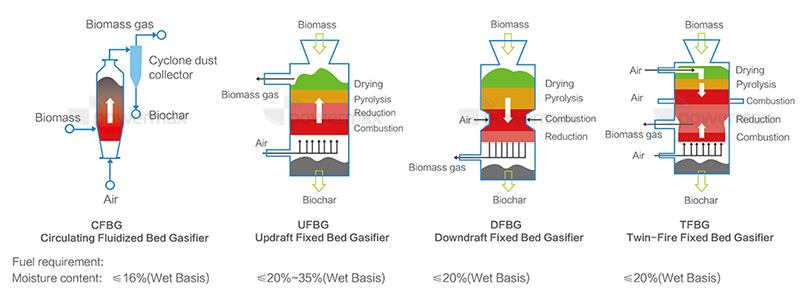
3. Primary Reactor Types
| Configuration | How It Works | Performance & Suitability |
|---|---|---|
| Fixed Bed Gasifier | Husks remain stationary on a fixed grate. |
• Efficiency: >60% • Simple, reliable, cost-effective. • Produces high-quality, intact biochar. • Best for small-to-medium-scale operations. |
| Fluidized Bed Gasifier | High-velocity airflow suspends particles like a boiling fluid. |
• Efficiency: Up to 80% • Faster reactions, higher throughput. • Requires precise control of material size and moisture. • Designed for large-scale, automated industrial operations. |
4. Core Advantages & Value Proposition
Waste-to-Energy: Converts an environmental liability (waste piles) into an economic asset (fuel and biochar).
Carbon Neutrality: The CO₂ released is offset by what the rice plants absorbed during growth, making it far more sustainable than fossil fuels.
High Efficiency: Achieves 70%–80% energy utilization, significantly outperforming direct combustion (which typically reaches 30%–50%).
High-Value Byproducts: The resulting biochar has multiple downstream markets:
Industrial: Green fuel or insulating agent in steel smelting.
Agricultural: Soil conditioner or carbon-based fertilizer.
Advanced Materials: Feedstock for Activated Carbon or White Carbon Black (Silica) used in rubber and chemical industries.
5. Key Applications
Combined Heat and Biochar (CHB): Simultaneously produces industrial heat and saleable biochar, reaching system efficiencies over 85%.
Community Gas Supply: Provides clean cooking gas for rural townships, replacing coal or firewood.
Combined Heat and Power (CHP): Drives boilers for steam or gas engines for grid-connected electricity generation.
High-Value Material Extraction: Further processes ash to extract high-purity Silica for industrial manufacturing.
6. Technical Challenges & Engineered Solutions
| Challenge | Root Cause | Engineered Solution |
|---|---|---|
| Tar Management | Gasification naturally produces tar that can clog pipelines. | High-Temperature Cracking within the reactor minimizes tar at the source, followed by multi-stage purification (cyclones, electrostatic precipitators). |
| Material Bridging | Low-density rice husks can "bridge" or get stuck in the hopper. | Optimized internal hopper geometry coupled with an automated feeding system ensures smooth, continuous flow. |
| Feedstock Logistics | Rice husk supply is seasonal. | A diversified supply chain strategy with proper storage facilities and long-term procurement contracts to guarantee year-round operation. |
7. Scalability: From Domestic to Industrial
Our technology is adaptable across a wide spectrum of needs:
Domestic Grade: Affordable cookstoves running on ~0.45 kg of husks per 20-minute cooking session.
Industrial Grade: Large-scale power plants (e.g., 1 MW capacity) capable of processing massive waste volumes to power entire local grids or industrial zones.
8. Global Market Opportunities & The Powermax Advantage
The global rice husk gasification market is expanding rapidly. There is a surging demand for efficient, cost-effective waste-to-energy solutions, particularly in major rice-producing regions such as the Asia-Pacific, Southeast Asia, and Africa. With over 30 years of expertise in biomass gasification, Wuxi Powermax is dedicated to transforming rice husk disposal challenges into clean energy and tangible profits.
We provide world-class, project-proven core technologies specifically engineered for rice husks. Because rice husks are lightweight, have poor flowability, and high ash content, standard gasifiers often suffer from feeding issues and tar blockages. Powermax has developed specialized solutions to overcome these exact pain points.
9. DFBG Downdraft Fixed Bed Gasifier
Specialized Equipment for Rice Husk Power Generation
This is our flagship technology designed for rice husks and other fine-particle feedstocks. It serves as the core technology for our 12MW landmark project in Myanmar.
Proprietary Design for Stable Operation: We have engineered custom feeding and discharge systems that adapt perfectly to the physical properties of rice husks. The system achieves continuous, stable operation without the need for complex pre-treatment.
Low Tar, High Reliability: Our core technology forces the gas to pass downward through a high-temperature carbon bed. This process thermally cracks tars into small-molecule combustible gases, fundamentally solving the issue of tar buildup in pipes and engines. This significantly reduces maintenance costs and downtime.
Dual Revenue Streams: The system enables Cogeneration (Gas & Charcoal). While generating electricity, you simultaneously produce high-value rice husk biochar that can be sold on the market, providing two distinct sources of ROI.
10. Flexible Product Configurations
Recognizing that every client has unique requirements regarding project scale, feedstock, and energy needs, we offer a versatile product line to ensure the most economical and efficient match.
For Large-Scale Power Projects: CFBG Circulating Fluidized Bed Gasifier
Scalability: Single-unit capacity ranges from 200kW to 3000kW. Multiple units can be configured in parallel to meet the demands of multi-megawatt utility-scale power plants.
Core Advantages: Specifically designed for fine-particle feedstocks (under 15mm). It features high gasification efficiency and stable output, with a gas heating value of 1200–1300 Kcal/Nm³, making it the ideal choice for large biomass plants.
Environmental Compliance: Equipped with advanced dry purification systems to ensure gas cleanliness and meet strict international emission standards.
For Distributed Energy: The Biowatt Integrated Solution
Plug-and-Play Efficiency: The Biowatt System integrates gasification, purification, power generation, and smart controls within a modular containerized design.
Rapid Deployment: Systems are pre-assembled at our factory. With no major civil engineering required on-site, they can be operational within 7–10 days.
Versatility: Provides a fast, independent power source (ranging from 100kW to 1000kW) for remote areas, commercial farms, or mining operations.